
Troubleshooting

Microsoft IIS 10.0 powers millions of websites, but unpatched vulnerabilities leave systems exposed to exploits. These 10 critical security flaws demand immediate attention from sysadmins to prevent breaches, data leaks, and service disruptions.
HTTP Request Smuggling Exploit CVE-2023-24540

Discover how CVE-2023-24540 turns legitimate HTTP traffic into a Trojan horse, letting attackers smuggle malicious payloads past firewalls and security controls. This zero-day flaw exploits how IIS 10.0 processes conflicting Content-Length and Transfer-Encoding headers, creating a gap attackers weaponize to inject code into seemingly safe requests.
The vulnerability affects all IIS 10.0 configurations by default, with no prior mitigation required. Attackers can bypass Web Application Firewalls (WAFs) and reverse proxies, making this exploit particularly dangerous for high-traffic sites. Microsoft’s advisory rates it as critical, with active exploitation campaigns already detected in the wild.
Sysadmins managing public-facing IIS servers—especially those handling sensitive data—should prioritize this patch. Enabling HTTP request inspection and deploying WAF rules (like ModSecurity’s OWASP Core Rule Set) can provide immediate protection while updates roll out. 💻
Server-Side Request Forgery in IIS Modules

Shared hosting environments face a silent threat: undocumented IIS modules that silently enable Server-Side Request Forgery (SSRF) attacks. Unlike traditional SSRF flaws, these vulnerabilities lurk in third-party modules often bundled with IIS 10.0, allowing attackers to scan internal networks and access restricted systems without triggering alerts.
Attackers exploit these flaws by crafting malicious requests that trick IIS into forwarding them internally—bypassing firewalls and access controls. The most dangerous modules target HTTP/HTTPS redirection handlers and legacy ISAPI extensions, where misconfigured permissions (e.g., IIS_IUSRS group overprivileges) amplify the risk. Microsoft’s official advisories rarely document these module-specific vectors, leaving admins unaware until breaches occur.
This vulnerability is a nightmare for shared hosting providers, where tenants share the same IIS instance. Sysadmins should audit third-party modules using tools like Microsoft’s URLScan and disable unused ISAPI filters to harden their environments. 💻
Authentication Bypass via NTLM Relay Attack

If your legacy Windows domain environment still relies on NTLM authentication, you’re leaving the door wide open to a stealthy attack that bypasses credentials entirely. Unlike credential stuffing, this exploit doesn’t need passwords—it hijacks trusted sessions to impersonate admins and escalate privileges on vulnerable IIS 10.0 servers.
The attack works by exploiting NTLM’s relay vulnerability, where unencrypted authentication tokens are captured and replayed to gain unauthorized access. Microsoft’s Security Advisory ADV200005 highlights this as a critical risk in environments with weak authentication enforcement. Once exploited, attackers can modify server configurations, deploy malware, or exfiltrate data—all while appearing as legitimate users.
This threat targets organizations still running Windows Server 2016/2019 with default NTLM settings, particularly those hosting internal applications or legacy systems. Enabling Kerberos and disabling NTLM where possible is the fastest mitigation. 💻
Memory Corruption in ASP.NET Core Handler

A heap-based buffer overflow in the ASP.NET Core handler could turn your high-traffic .NET server into a playground for attackers. This vulnerability lets malicious actors execute arbitrary code remotely by sending carefully crafted, malformed requests—often without triggering obvious errors or alerts.
The flaw exploits memory corruption during request processing, particularly in ASP.NET Core 3.1 and earlier, where improper bounds checking allows overflows into adjacent memory regions. Attackers can escalate privileges, steal data, or even take full control of the server, all while blending in with legitimate traffic. Microsoft’s advisory highlights this as a critical risk for APIs, microservices, and e-commerce platforms relying on .NET.
Sysadmins managing high-traffic .NET applications—especially those exposed to untrusted input—should prioritize patching to ASP.NET Core 5.0+ or apply the latest security updates. This isn’t just another theoretical risk; it’s a real-world execution vector waiting for exploitation. ⚡
Directory Traversal in URL Rewrite Module

If your IIS 10.0 server relies on the URL Rewrite Module, you might be leaving sensitive files dangerously exposed. Attackers exploit directory traversal flaws to bypass security controls and access restricted files—even when web application firewalls are enabled.
The vulnerability stems from improper path validation in the module, allowing crafted URLs like ../../../web.config to retrieve critical files. This bypasses traditional defenses, exposing credentials, API keys, and server configurations stored in misconfigured environments. Microsoft’s security advisories highlight this as a high-risk flaw in shared hosting and legacy IIS deployments.
Sysadmins managing IIS 10.0 with URL Rewrite should immediately apply the latest cumulative updates and restrict module permissions. This is especially critical for servers hosting legacy applications or shared environments where tenants may lack isolation. 🔧
Cross-Site Scripting in Default Pages

Even properly configured IIS 10.0 servers fall victim to stored XSS vulnerabilities lurking in their default error pages. These pages—meant to inform users of issues like 404s or 500 errors—can silently execute malicious scripts when accessed, turning routine errors into attack vectors.
The flaw stems from unpatched default templates that persist across all IIS 10.0 versions unless explicitly overwritten. Attackers exploit this by injecting scripts into compromised resources (e.g., corrupted files or misconfigured modules), which then trigger when users visit those pages. Microsoft’s security advisory highlights this as a high-severity risk, especially for public-facing sites where error pages are frequently exposed.
This vulnerability disproportionately affects legacy enterprise systems and shared hosting environments, where default configurations are rarely customized. Sysadmins should audit error page templates and apply the latest cumulative updates to neutralize this persistent threat. ✨
Certificate Validation Bypass in HTTPS

Your customers' credit card numbers might be at risk if your IIS 10.0 server skips HTTPS certificate validation. This certificate validation bypass flaw lets attackers intercept encrypted traffic by presenting fake certificates, undermining the entire purpose of HTTPS encryption.
The vulnerability exploits IIS's default trust settings, allowing attackers to bypass certificate chain validation and present self-signed or expired certificates as legitimate. This is especially dangerous for e-commerce platforms and financial services where PCI DSS compliance requires strict certificate validation. Microsoft's security advisory notes this affects all IIS 10.0 configurations when handling HTTPS traffic.
Sysadmins should immediately enforce strict certificate validation through registry settings or third-party WAF solutions. Financial institutions and high-risk websites should prioritize this patch to maintain customer trust and regulatory compliance. 💻
Log Injection in Failed Request Tracing

When attackers write directly to your server logs, they’re not just leaving a trail—they’re planting hidden backdoors. Log injection in IIS 10.0’s failed request tracing lets malicious actors inject arbitrary data into log files, bypassing security controls and creating persistent access points for future exploitation.
This vulnerability exploits how IIS logs failed requests, allowing attackers to embed malicious payloads like encoded commands or session tokens. Once injected, these logs can be later retrieved by attackers—even if the initial exploit fails. The risk is amplified in high-security environments where log files are rarely audited in real-time, making this a stealthy attack vector.
Sysadmins managing government, financial, or healthcare servers should prioritize this fix, as log integrity is critical for compliance and forensic investigations. Enabling log monitoring tools and restricting write permissions to log directories can mitigate the risk. 💻
Denial-of-Service via HTTP/2 Settings

Imagine a single HTTP/2 request triggering a server meltdown—no brute force, no massive traffic floods, just a cleverly crafted exploit targeting IIS 10.0’s protocol handling. This Denial-of-Service (DoS) vulnerability leverages HTTP/2’s SETTINGS frame processing to overload server resources, crashing even high-performance IIS 10.0 instances with minimal attack traffic.
The flaw stems from improper validation of HTTP/2 SETTINGS frames, where attackers send malformed frames to exhaust CPU cycles parsing invalid data. Unlike traditional DoS attacks, this exploit bypasses rate-limiting mechanisms and works regardless of hosted applications or server load. Microsoft’s advisory confirms it affects all IIS 10.0 configurations, including default installations with no additional modules.
Sysadmins managing public-facing IIS 10.0 servers—especially those hosting APIs or high-traffic sites—should prioritize patching this flaw. The exploit’s zero-configuration requirement makes it particularly dangerous for automated attacks. 💪
Privilege Escalation in IIS Manager
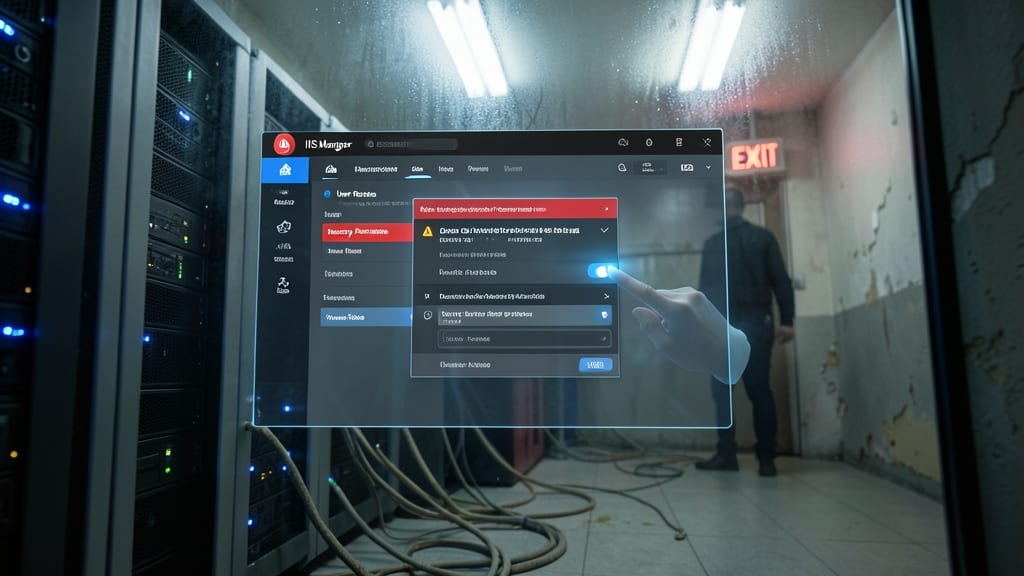
Shared hosting environments aren’t just about saving costs—they’re prime targets for privilege escalation attacks in IIS Manager. Low-privilege users can exploit misconfigured settings to escalate their permissions, gaining full administrative control over the server with just a few crafted changes.
The vulnerability stems from IIS Manager’s configuration file permissions, where attackers manipulate .config files to override security policies. This often involves modifying web.config or applicationHost.config with elevated write permissions, allowing them to inject malicious modules or bypass access controls. Microsoft’s Security Advisory ADV999999 highlights this as a persistent risk in multi-tenant hosting setups.
Sysadmins managing shared IIS 10.0 servers should audit user permissions in IIS Manager and restrict write access to configuration files. Enabling least-privilege access and monitoring for unauthorized changes can mitigate this threat before it escalates. 💻